Joint Projects Connect Our Networks
Project 1. PeaceBrook Community meals at rotating locations.
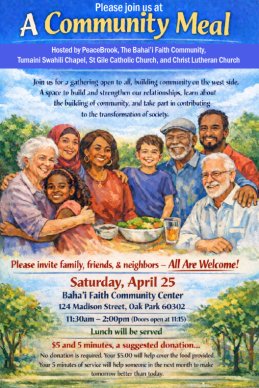
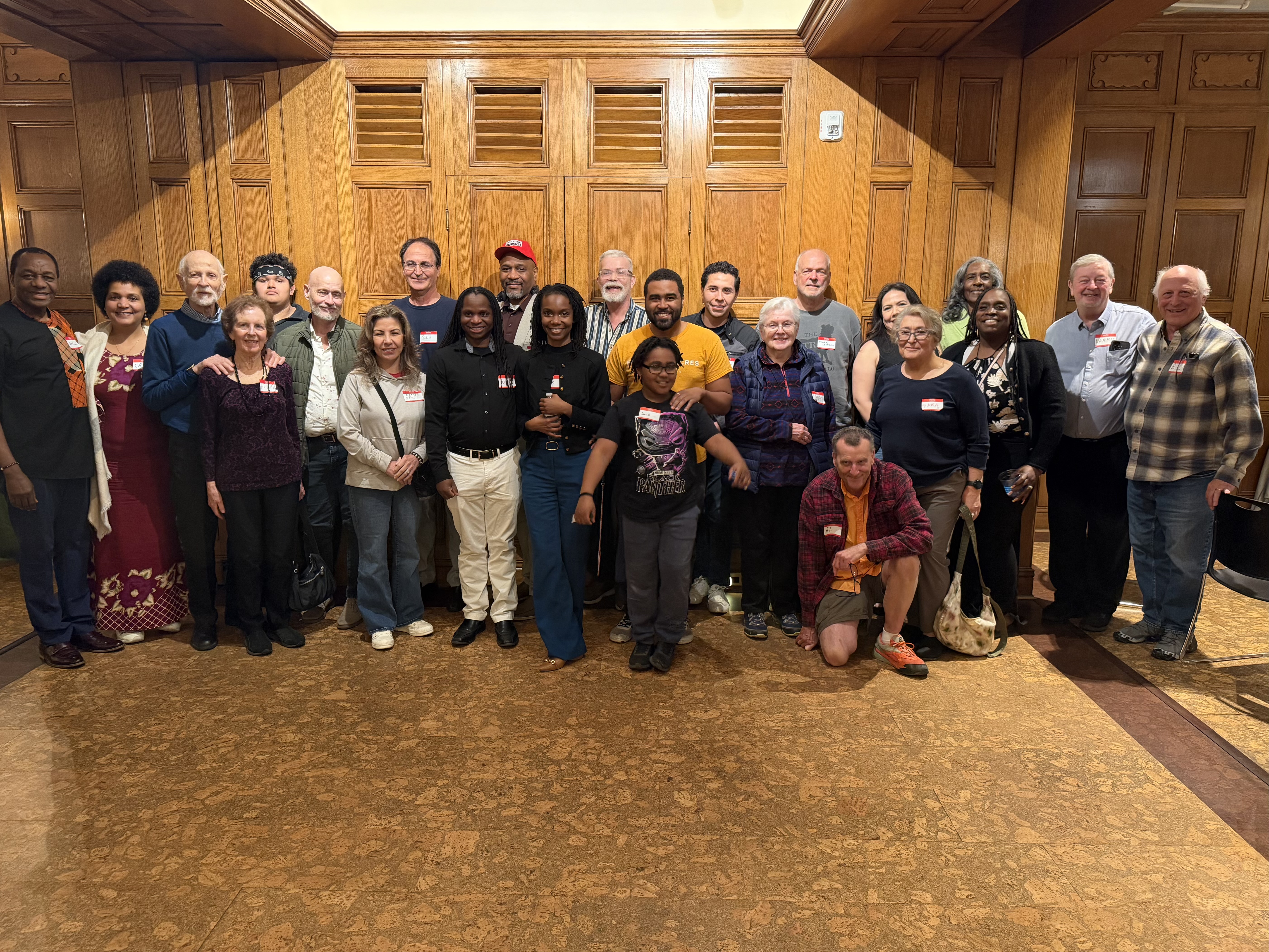
Our first community meal was a joint project hosted by the B’hai Faith Community, Tumaini Swahili Chapel, St Giles Catholic Church, Christ Lutheran Church, and the PeaceBrook community. We shared food and fellowship on Sat, Apr 25, 2026.
All are welcome to our community meals! Please invite family, friends, and neighbors.
$5 and 5 minutes are suggested donations. No donation is required. Your $5 helps cover the food we provide. Your 5 minutes of service helps someone in the next month make tomorrow better than today.
Project 2. Parking tickets — a proposal to Chicagoland governments
People pay with EITHER time (through community service) OR dollars
Here’s how the program could work:
A $35 fine could be paid with about 2 hours of community service work (if minimum wage rates were used).
People who want to pay their fines with community service would fill out a questionnaire listing their skills, availability among the offered time slots, education level, and physical limitations.
They would have 90 days to complete their work obligation with a satisfactory review by the work supervisor.
Not-for-profits and churches would apply to receive the community service work.
Further details could be modeled after the Cook County Court-ordered community service program: http://www.cookcountycourt.org/ABOUTTHECOURT/OfficeoftheChiefJudge/ProbationDepartments/ProbationforAdults/SocialServiceDepartment/CommunityServiceProgram.aspx
Similar programs in other cities:
Los Angeles to allow homeless to pay parking tickets with community service https://abc7.com/news/la-to-allow-homeless-to-pay-parking-tickets-with-community-service/1755189/
San Francisco's Municipal Transit Agency provides customers the option to perform community service in San Francisco in lieu of parking ticket and transit citation payment. https://www.sfmta.com/getting-around/drive-park/citations/community-service-program
Benefits
People with few dollars can pay their fines by doing community service
They work for not-for-profits, meet good people, and strengthen the community
The message is everyone is part of our community, precious, and needed
Paying parking tickets with time - a step toward Good Money Chicago 2028
Having local or State governments enable people to pay a fine or fee with their time gives institutional recognition to what people already know - time is precious. It will encourage people to use time as a means of exchange, thus giving people short on dollars a way to get what they need.
Chicago will be A Good Money City by the Summer of 2028. People will be able to get most essentials with either their dollar or time account. People prefer to use their time credit because it's more personal and saves their dollars for gasoline, which they can get only with dollars.
If you owe some hours on your TimeExchanges bill, you pay for them by helping people or groups you know. When you help your neighbor Mary for 2 hours or help out at your local school, you debit their time account for those 2 hours and credit your account.
Projects connect our circles & networks
We all have circles of people with whom we are connected — our family members, people we know from our block and neighborhood, and those we meet through sports and other activities involving our children. Some of us have lots and lots of circles.
These circles strengthen and support us in our lives and in our networks.
We may also be in networks through our work, faith community, a third place we frequent, or political connections.
These networks involve more relationships and give us access to information, opportunities, and resources we don't have in our tight circles. They give us influence in complex systems.
Our local social justice network is part of the 1 to 2 million organizations worldwide that are involved in environmental and social justice work.
Joint projects--networks connecting and working together
Effective change flows both up from the grassroots and down from those with broader reach.
We can exponentially increase our positive impacts by recognizing our oneness and coordinating our activities. Eg, John and I, each with our own networks, can both list our events in the PeaceBrook Calendar. We can go further by coordinating our events, jointly putting out word in each of our networks. When I participate in John's events, I support him, meet people in his network, and extend my reach. Of course, John has the same opportunity with my events. The more reach and power each of us has, the more we are able to get things done to have tomorrow be the one we want.
References to help us go further:
- The Chessboard and the Web: Strategies of Connection in a Networked World, by Anne-Marie Slaughter. Networks are everywhere--networks through kinship, tribe, friends, work...--and have immense potential power.
- Blessed Unrest, by Paul Hawken
- Natural Capitalism, by Paul Hawken & Amory & Hunter Lovins. The "next industrial revolution" depends on four central strategies: "the conservation of resources through more effective manufacturing processes, the reuse of materials as found in natural systems, a change in values from quantity to quality, and investing in natural capital, or restoring and sustaining natural resources"
- Love is the Answer (no matter the question), by Gerald G. Jampolsky MD and Diane V. Cirincione
- City of Refuge & Fifth Sacred Thing, two novels by the author Starhawk.
- Humankind: A Hopeful History, by Rutger Bregman, Thomas Judd, et al.
- Little Book of Stoicism: Timeless Wisdom to Gain Resilience, Confidence, and Calmness, by
- Emile Durkheim is the father of sociology. His theory is that society is a system guided by social facts and shared norms and values that shape behavior. Social order is maintained through solidarity; religion and morality are central to social life.